Waldorf, Maryland
Gas Dryer Repair in Waldorf, MD
Gas Dryer Repair in Waldorf, Maryland, with the published national price range up front, the failed part confirmed by testing on site, and the repair price stated before any work begins.
Waldorf, Maryland
Gas Dryer Repair in Waldorf, Maryland, with the published national price range up front, the failed part confirmed by testing on site, and the repair price stated before any work begins.
When a gas dryer tumbles happily and dries nothing, the drum is not the problem. The heat never arrived, or it arrived for ten minutes and quit. That pattern is the signature of the most common gas dryer failure we see and it fools people into running load after load through a machine that only tumbles. Our work is the component work inside the dryer itself: igniters, valve coils, flame sensors, fuses, and thermostats, tested in sequence.
A gas dryer lights its burner through a chain of parts that all have to agree. The igniter glows hot, the flame sensor watches it, and the valve coils open to let gas flow to the burner. When the igniter weakens with age, it may glow orange but never draw enough current, and the burner never lights.
The valve coils are the tricksters. They weaken as they warm up, so a dryer with tired coils heats perfectly early in a cycle, then quietly stops firing and leaves the load tumbling cold. The fix is a modest part, not a new machine. Thermal fuses and thermostats fail too, usually from heat buildup in a lint-clogged vent run, which is why we check the internal lint path on every no-heat call: a dryer fighting a clogged vent cooks its own safety parts.
One boundary, stated plainly: we work on components inside the dryer. The gas line itself, and the home's wiring, belong to other trades. If you smell gas around the dryer, treat it as a utility matter first.
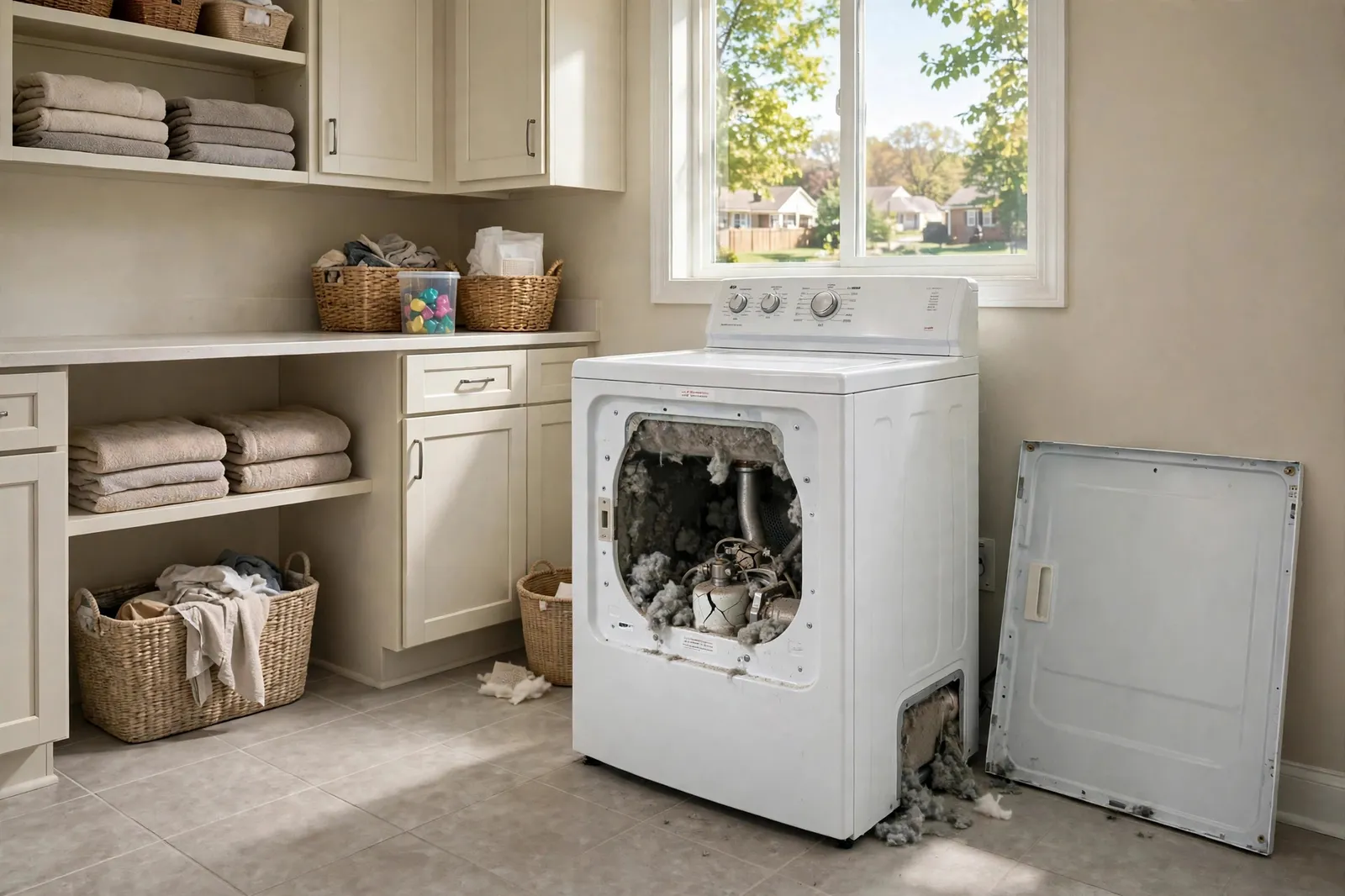
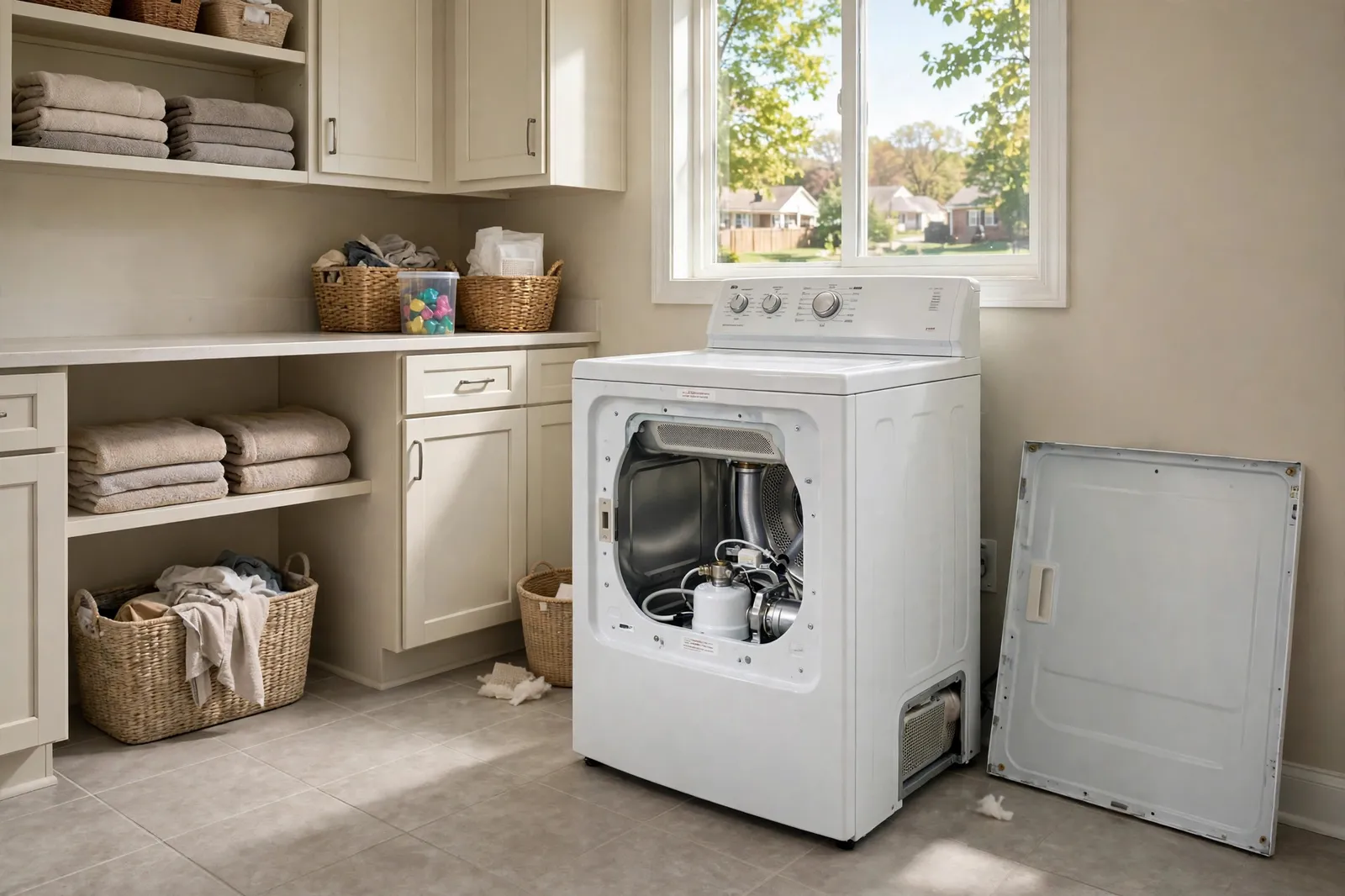
A Pinefield homeowner's gas dryer heated for the first stretch of every cycle, then tumbled the load cold to the end. On site, we watched the burner light twice, then fail to fire again as the machine warmed. The igniter tested weak, and the valve coils tested open once hot, the classic pair behind this symptom. We replaced both coils and the igniter, cleared the internal lint path, and ran two full cycles with a wet load to confirm the burner kept firing throughout.
No Waldorf shop publishes a local price list, so these are published national ranges, labeled as national. Angi's 2026 data puts dryer repair between $100 and $400, with the average repair at about $170, typically $100 to $240. Housecall Pro shows most jobs between $107 and $249. Igniters, coils, sensors, and fuses sit in the lower and middle of that range; motors and control boards pull toward the top. The job above is the shape of most no-heat calls: modest components plus the testing time to prove them.
Gas dryer diagnosis means watching the machine work. Coils that fail hot pass cold tests easily, so we run real heat cycles and watch the burner as the machine warms. We test the igniter's draw, the flame sensor, and the fuse and thermostat chain, then match the tests to what the burner did. After the repair, a full loaded cycle confirms the burner fires from cold start to dry load. A dryer that heats once and quits is not fixed.
Use the quote form at the bottom of this page. Tell us the brand and what the dryer does: no heat at all, heat that quits partway, or a drum that will not turn. Add the model number from inside the door if you can. The timing pattern is real diagnostic information, so describe it exactly as you have seen it.
That pattern almost always means the valve coils are failing as they warm up. Worn coils work while cool and give out once hot, so the dryer heats early and tumbles cold afterward. The pair is a modest replacement.
A glowing igniter is not always a working one. Weakened igniters can glow without drawing enough current to open the gas valve, and the cause can also sit in the coils or flame sensor. Testing the ignition chain separates them.
Published national ranges are the guide. Angi's 2026 data puts dryer repair between $100 and $400, with most appliance repairs between $100 and $240. Igniters, coils, and sensors sit low; motors and control boards sit at the top.
No. Our work is the components inside the dryer: igniters, valve coils, sensors, and fuses. The gas line belongs to the gas trade and house wiring to the electrical trade. We stay inside our scope.
Very often. A vent packed with lint traps heat, and that heat kills thermal fuses and strains igniters. We check the internal lint path on every no-heat call. A dryer that keeps blowing fuses needs its vent cleared.
Waldorf homes' gas dryers: Whirlpool, Maytag, GE, Samsung, LG, and Kenmore. If your brand is less common, name it in the quote form and we will tell you straight whether we take it on.
Tell us which appliance is down and what it is doing. We read every request that comes in and respond with the published national range for that kind of repair and the next step, starting with a visit to test and confirm the failed part on site.
Prefer to talk it through first? Send the form and we will call you back at the number you give us.